How to Set Career Goals That Actually Move You Forward
By Ingashian Gibendi, Career Strategist and Founder of The Career Whisperer
What am I even aiming for? Why does everyone else seem to know where they're going? If those questions have been running through your head lately, you're not behind, and you're far from the only one.
Career goals are the specific things you want your working life to give you, such as the role you're aiming for, the skills you want to build and the growth you want over time, written down as steps you can act on. Setting career goals means choosing a direction first, then breaking it into small, dated actions, so your job search stops being random.
Most advice tells you to set goals and stops there. The list isn't the hard part. Choosing a direction is. Without one, every job advert looks like a possible yes, and every rejection starts to feel like a verdict on you.
Our Career Audit Quiz data shows how common this is. Out of the 31,000+ African job seekers who've completed it, 51% told us they apply to anything they think they might qualify for. Only 31% have a clear target based on the role, the industry and the value they bring. Another 8% say they feel stuck or unclear about what they're even looking for. Strategy, the quiz category that measures this, averages 63% across all respondents.
Writing your goals down helps, and there's research behind it. A study by Dr Gail Matthews at Dominican University found that people who wrote down their goals, committed to specific actions and sent a friend weekly progress updates had achieved or were halfway to their goals 76% of the time, compared with 43% of people who only thought about them. Direction, a written plan and regular check-ins are the pattern this guide follows.

Most job seekers are applying without a clear target. Here's what our Career Audit Quiz data shows.
How to set career goals, step by step
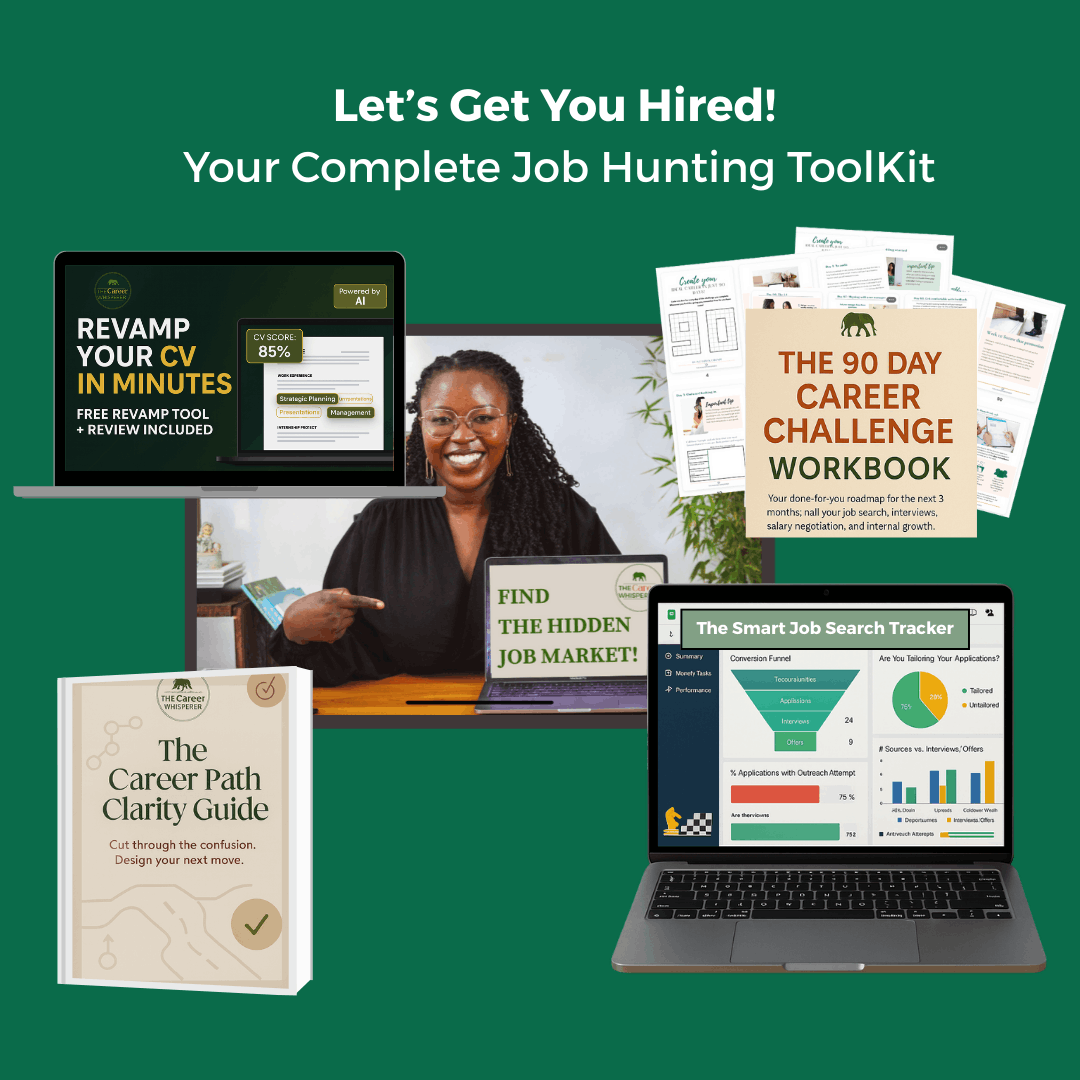
You don't need a five-year plan to set career goals. You need an honest, structured look at where you actually are before you decide where to go. This is the same order we take job seekers through in the Career Path Clarity Guide, a 90-minute audit broken into four parts.
Step 1: Get honest about where you are now
Before you touch a goal, write down your current role, your top five responsibilities and where your time actually goes. Then do an energy audit: which tasks drain you, which ones you'd happily do more of, and how you'd rate your company culture and manager fit. Most people skip this and go straight to "what job should I get next," which is why the next job often repeats the same problems
Step 2: Get honest about who you are
List the five values that matter most to you, your work non-negotiables (salary, flexibility, growth, benefits) and the strengths you want to keep using. Two moments where you felt genuinely in your element tell you more about your direction than any job title does.
Step 3: Design three real options, not one guess
Using what you learned in steps one and two, sketch three paths: Stay + Grow (advance where you are), Career Pivot (move into something new) and a Blended Path (combine your current work with a new interest or project). For each, write what excites you, what worries you and what success would look like. Then run them through a short set of clarity prompts, such as "do I enjoy what I do but feel stuck where I do it?" and "if nothing changed in 12 months, would I be content or disappointed?", to see which path actually holds up.
Step 4: Take action with purpose
Pick the path, name the one step you'll take in the next seven days, choose an accountability buddy and set a check-in date within the month. A goal without a date and a witness is just a nice paragraph
The review step is the one people skip entirely. In our quiz data, 41% of job seekers say they rarely stop to look at what's working in their search, and another 22% never do. That's why Part 4 builds the check-in date into the process instead of leaving it to willpower.
This whole sequence, worksheet and all, is the Career Path Clarity Guide.

The exact worksheet behind the method in this post
Once the goal is written down, it needs to be sharp enough to test, and that's where the SMART method earns its place.
SMART career goals, with before and after examples
A SMART career goal is a goal that's Specific, Measurable, Achievable, Relevant and Time-bound. It's a simple test for whether your goal is clear enough to act on, and it's the reason "get a better job" rarely moves anyone forward.
- Specific: it names the role, the industry or the place
- Measurable: it has a number you can count.
- Achievable: it stretches you without ignoring your current situation.
- Relevant: it points at the direction you chose in step three.
- Time-bound: it has a date or a timeframe attached.
The table below shows four vague goals rewritten as smart career goals. Notice that each rewrite gives you a specific timeline.
| Vague goal | SMART version |
| Get a better job | Send five tailored applications a week for marketing officer roles at consumer goods companies in Nairobi, for the next 12 weeks. |
| Improve my skills | Finish a beginner data analysis course and complete two portfolio projects within 90 days, so I can apply for junior analyst roles. |
| Grow my network | Message five people in my target industry each week and book two conversations a month for the next three months. |
| Get promoted | Take on one project that shows leadership, agree how it will be measured with my manager, and review my progress with them in six months. |
The difference between the two columns isn't ambition. It's that the right-hand column gives your effort somewhere to go. In our quiz data, 46% of job seekers say they try to apply regularly but don't go beyond that. A measurable goal is what turns regular effort into progress you can see.
Your goal now has a shape. The next question is how the goals you'll reach this year connect to the ones that take longer.
Short-term and long-term goals
Short-term and long-term goals do different jobs. Short-term goals build skills, evidence and momentum. Long-term goals keep you pointed in one direction when a tempting but wrong opportunity shows up.
| Short-term goals | Long-term goals | |
| Timeframe | Up to 12 months | 3 to 5 years |
| What they do | Build skills, proof and momentum | Set your direction |
| Example | Get my first role in project coordination |
Lead a project management team |
| How often to review | Weekly | Every six months |
Short-term goals examples
- These short-term goal examples work for the next 12 months.
- Tailor your CV to one target role and send it to ten real openings in the next 30 days.
- Book three conversations with people already doing the job you want, in the next 60 days.
- Complete one course or certification hiring managers in your field recognise, within six months.
- Build one piece of work you can show, such as a report or case study, by the end of the quarter.
Long-term goals examples
Long-term goals examples look three to five years ahead and only need a clear direction.
- Move from an entry-level role into a team lead or manager position in your field within five years.
- Build a career that can travel, such as a regional role in East Africa or a remote role with an international employer.
- Move from a general role into a specialist one, such as finance into financial analysis or marketing into brand strategy.
- Become the person colleagues and recruiters in your industry think of first when a role like yours opens up.
Each short-term goal should be a step towards a long-term one, and if they don't connect, one of them needs to change. Keep the long-term goal loose and the short-term goal sharp, because your direction will get clearer as you learn what suits you. The examples below show what that looks like from different starting points.
Career goals examples for students and professionals
Career goals examples are a starting point, not a script. Copy the shape, then change the details until they're true for you.
Career goals examples for students and graduates
- If you're a student or recent graduate, your goals are usually about direction, evidence and first access to the market.
- Pick two career directions you're curious about and spend a month testing each, through a course, a small project or a day of shadowing.
- Complete one internship, volunteer project or personal project that shows your skills in action.
- Build a LinkedIn profile that says clearly what you're studying and what you want to do next. Our guide on how to use LinkedIn to get a job in Africa shows you where to start.
- Apply for five graduate programmes or entry-level roles a week that fit one chosen direction.
Professional goals examples for people already working
Professional goals for people already working tend to be about growth, responsibility and moving with intention.
- Take on one stretch project this quarter that shows you can lead.
- Learn one skill your target role asks for and use it in your current job within six months.
- Agree a development plan with your manager and review it every quarter.
- Update your CV every quarter with one new, measurable result, so you're never starting from scratch when an opportunity appears.
Whichever set you choose, you'll be asked to say your goal out loud sooner than you think, usually in an interview.
What to say when an interviewer asks about your career goals
If you've ever typed "what is your career goals best answer" into Google, you've probably found a pile of scripts. Scripts don't work because interviewers can hear them. A simple structure that you fill with your own details does.
- Where you are now: one line on your current skills or focus.
- Where you're heading: the direction over the next two to three years, in terms of skills and responsibility rather than job titles.
- Why this role: how this job moves you along that path.
 A simple structure that beats a memorized script.
For freshers and students, it might sound like this: "I've just finished my degree in economics and I've been building my analysis skills through a research project. Over the next few years I want to grow into a role where I'm trusted with client-facing analysis, and this graduate programme gives me structured training towards that."
For experienced professionals, it might sound like this: "I've spent four years in operations, and my strongest results have come from improving processes. Over the next few years I want to lead a small team doing that work, and this role's focus on process improvement is the natural next step."
Confidence in this answer is lower than most people expect. When the quiz asks "Why should we hire you?", only 33% say they can clearly link their experience to what an employer needs. Another 47% are somewhat confident, 12% ramble and 7% freeze. A written career goal gives you the raw material for a clear answer, and our guide to common job interview questions and the best answers covers what usually comes next.
Once you've practised this, the interview stops being the moment you're guessing and becomes the moment you're explaining a plan you already have.
What I've Seen Work in Practice
I've sat with thousands of job seekers over the years, and the ones who moved fastest weren't the ones with the longest goal lists. They were the ones who could say no.
I found that out the hard way. A few months back, an offer came in for a role in Dubai. Good title, good money, the kind of offer that looks like proof you've made it. A year earlier I would have said yes before I'd finished reading the email. This time I sat with it for a few days instead, because I'd just been through my own Clarity Guide audit and I actually had something to check it against.
Part 1 made me admit that what was draining me in my current work wasn't the work itself, it was the constant context switching. Part 2 reminded me that flexibility and being near my support system sat higher on my non-negotiables list than salary did, even though salary is the one people assume matters most. When I ran the Dubai offer through the clarity prompts in Part 3, one question did the damage: if nothing changed in 12 months, would I be content or disappointed? The honest answer was that I'd have more money and less of everything else I'd just written down.
So I turned it down. Not because the role was bad. Because it wasn't my role. A written direction doesn't make decisions easy. It makes them yours, and it means you're saying no for a reason you can actually point to, instead of a feeling you can't explain to anyone, including yourself.
Frequently Asked Questions
What are the top 3 career goals?
There isn't an official list. In my experience, most career plans come back to three things: building a skill employers value, moving into a role with more responsibility, and earning more or gaining stability. Choose the one that matters most to you right now and write it as a SMART goal. Chasing all three at once is the fastest way to lose direction.
What is the best career goal?
The best career goal is one you can describe in a single sentence, that fits what you want right now and that you can act on this week. "Be successful" can't be acted on. "Move into a junior data analyst role at a fintech within 12 months" can. You can change it later, but you need something specific to test first.
What to say when your boss asks about career goals?
Be honest about the direction you're heading and name the skills you want to build. Connect them to what the team needs so your goals sound like growth and not an exit. For example: "I'd like to take on more client-facing work over the next year, and I think I can help the team with reporting while I build that skill."
What are the 7 types of goals?
There's no single official list, but the seven types most often named are career, financial, health, relationships, learning, personal growth and spiritual goals. Your career goals sit in the first group, and they often depend on the others. A financial goal, for example, shapes how much risk you can take when you're deciding whether to move jobs.
Choose a Direction, Then Write It Down
Good career goals are specific enough to act on this week and honest enough to still matter in March. You take an honest look at where you are and who you are, design real options instead of one guess, write the goal as a SMART goal and check in on a fixed date. That's the whole method. The difference between the people who get where they're going and the ones who stay stuck is rarely talent. It's usually having a clear direction and a system to follow it, and that's exactly what the 90-minute Career Path Clarity Guide audit is built to give you.
Want to know exactly where your job search is breaking down? Take the free Career Audit Quiz. It takes 4 minutes and tells you precisely what to fix first.