Common Job Interview Questions and the Best Answers
By Ingashian Gibendi, Career Strategist and Founder of The Career Whisperer
You've got the interview. You've been waiting for this. Now you're sitting in your room the night before, running through questions in your head, and nothing you're thinking of sounds quite right.
Common job interview questions and the best answers are not about memorising scripts. They're about knowing what the interviewer is really asking underneath each question, and having a clear, confident response ready before you walk in.
According to the International Labour Organisation, over 12 million young Africans enter the job market every year, but only 3 million formal jobs are created. The roles available cannot absorb them all, which means every interview you get is competitive. Getting called in is hard enough. Losing the role because of how you answered a question you could have prepared for is a different kind of painful.
In our Career Audit Quiz, which over 30,000 African job seekers have completed, Conversion is the lowest-scoring category, averaging just 53%. That means most people are not losing jobs because they can't find roles to apply for. They're losing them at the point where it matters most: the interview room.
The good news is that interviewers use the same questions over and over again. Not because they're lazy. Because they work. What changes is how you answer them.
If your cover letter and job application letter got you this far, this is the guide for what comes next.
What are the most common job interview questions?
Every interviewer has their own style, but the core questions stay remarkably consistent across industries and countries. Understanding what each question is really asking gives you a real edge before you've said a word.
Here are the seven most common job interview questions, what the interviewer is actually trying to find out, and the best approach to each.
| Question | What the interviewer is really asking | Best answer approach |
| Tell me about yourself? | Can you communicate clearly, and do you understand what this role needs? | Brief career summary + why you're here + what you bring |
| Why should we hire you? | Do you know your own value and can you connect it to our specific problem? | Skills + evidence + specific fit to this role |
| What are your strengths? | Are you self-aware and are your strengths actually relevant to us? | One or two real strengths with a brief example each |
| What are your weaknesses? | Are you honest and do you take your own development seriously? | A genuine weakness + what you're actively doing about it |
| Where do you see yourself in 5 years? | Will you stay, grow, and contribute, or are we just a stepping stone? | Ambition that genuinely aligns with the company's direction |
| Why do you want to work here? | Have you done your research, or are you applying to everyone? | Something specific about this company, not generic praise |
| Do you have any questions for us? | Are you serious about this role, or just going through the motions? | Two or three thoughtful questions about the role or team |
How long should your interview answers be?
Most answers should run between 60 and 90 seconds. That's roughly two to three sentences of context, one concrete example, and a closing statement. Shorter and you risk sounding unprepared. Longer and you risk losing the interviewer's attention. The one exception is behavioural questions answered using the STAR method, which can run slightly longer if the example genuinely requires it.
Tell me about yourself: how to actually answer it
This is almost always the first question. Most people answer it by reciting their CV out loud. That is not what the interviewer wants.
What they want is to understand who you are professionally, why you're in this room, and why you're relevant to this role. Your answer should do all three things in under 90 seconds.
What is a good "tell me about yourself" sample answer?
Here is a structure that works every time:
"I'm a [job title or field] with [X years of experience / I recently completed my degree in X]. My background is in [key area], where I've focused on [specific thing you do well]. Most recently, I [brief achievement or responsibility]. I'm now looking for a role where I can [what you want to contribute], which is why this position at [company] genuinely interested me."
Know the shape of this answer, not the word-for-word script. It should sound natural, like you're telling someone who you are, not reading from a document.
How long should your "tell me about yourself" answer be?
Sixty to ninety seconds. Practise it out loud, not just in your head. Most people are surprised by how long 90 seconds actually feels when you're the one talking.
Why should we hire you?
This is where our quiz data is most telling. When we asked African job seekers how confident they feel answering it, 7% said they freeze entirely and a further 13% said they try but can't find the right words. That's one in five people walking into an interview unable to answer the one question every interviewer asks.
The reason people freeze is that the question feels arrogant to answer directly. It's not. It's an invitation to make the case for yourself, and the interviewer wants to hear it.
How do you answer "why should we hire you" with no experience?
If you're early in your career, lead with transferable skills and genuine enthusiasm backed by evidence. "I don't have three years of direct experience in this specific role, but I've spent the last year doing X, which taught me Y. I bring Z, and I'm committed to learning the rest quickly." Honesty paired with specifics is far stronger than a vague claim about being a hard worker.
What is a strong example answer for "why should we hire you"?
"You should hire me because I bring a specific combination of [skill A] and [skill B] that directly matches what this role requires. In my previous role at [company], I [specific achievement with a measurable result]. I've done my research on what your team is working on and I'm confident I can contribute from day one."
Replace the brackets with your real details. The formula is: relevant skills + evidence + specific fit.
What are your strengths and weaknesses?
Strengths are where people oversell. Weaknesses are where people lie. Both approaches fail.
For strengths, name one or two that are directly relevant to the role and back each with a brief example. "I'm a strong communicator" is forgettable. "I'm a strong communicator. In my last role I led weekly client briefings that reduced revision rounds by about 40%" is memorable.
What are good weaknesses to mention in a job interview?
Choose a weakness that is real but not central to the role you're applying for. Then explain what you're actively doing to address it. "I used to struggle with public speaking. Over the past six months I've been attending a local Toastmasters group and I've already presented twice this quarter." That answer shows honesty, self-awareness, and initiative. Three things every interviewer wants to see.
What is your best answer to " What are your 3 weaknesses? "
If asked for three weaknesses specifically, choose one that is skill-based (something technical you're developing), one that is behavioural (something about how you work), and one that is contextual (something you're less experienced in but actively learning). Keep each answer brief and always close with what you're actively doing to address it.
How to answer behavioural questions using the STAR method
Behavioural questions ask you to describe a past situation. They usually start with "tell me about a time when..." or "give me an example of..." These questions exist because past behaviour is the strongest predictor of future behaviour.
The STAR method gives your answer a clear structure so the interviewer can follow it easily.
What does STAR stand for in interviews?
- Situation: Set the scene briefly. Where were you and what was the context?
- Task: What was your specific responsibility in that situation?
- Action: What did you actually do? This is the most important part. Be specific about your individual actions, not what the team did.
- Result: What happened because of what you did? Use numbers where you can: percentages, timelines, and outcomes.
 Use the STAR method to structure your answers to behavioural interview questions clearly and confidently.
What is the 10-second rule in an interview?
Research shows that interviewers form an initial impression within the first few seconds of meeting a candidate, before a single question has been asked. Walk in with good posture, make eye contact, greet the interviewer by name, and sit only when invited to. That opening moment sets the tone for everything that follows, and it's entirely within your control.
What are the 5 C's of interviewing?
Every interview question is testing one or more of these five things:
| The C | What the interviewer is really checking |
| Competence | Can you do the job? |
| Communication | Can you explain yourself clearly? |
| Confidence | Do you believe in your own ability? |
| Connection | Can you build rapport quickly? |
| Culture fit | Will you work well with this team? |
When you understand which C a question is targeting, your answer becomes far more focused.
How long should a STAR method answer be?
Between 90 seconds and two minutes. Practise the answer out loud so you know where you tend to over-explain. The Action step should take up roughly half your total answer. It's the part the interviewer is most interested in.
What are your salary expectations?
This question makes most job seekers panic, especially when they don't know the local market rate. The goal is not to give a number that prices you out, or undersells you. It's to give a range that is grounded in research.
What should you say when asked about salary in an interview?
Research the typical range for this role in your city before the interview. LinkedIn Salary, Glassdoor, and local job boards all carry this data. Then give a range: "Based on my research and the scope of this role, I'm looking at something in the range of X to Y, though I'm open to discussing the full package." A range gives you room to negotiate. A single number gives you none.
How do you answer salary questions when you don't know the market rate?
If you genuinely don't know, say so honestly and ask about the budgeted range first. "I want to make sure we're aligned. Could you share what range you have in mind for this role?" This is not evasive. It's practical, and most interviewers will respect the directness.
What questions should you ask at the end of an interview?
"Do you have any questions for us?" is not a formality. It is the last impression you leave. Candidates who ask thoughtful questions signal that they've thought seriously about the role and the company. Candidates who say "no, I think we covered everything" signal that they just want a job, not this job specifically.
What are killer questions to ask at the end of an interview?
These three consistently land well. "What does success look like in this role in the first 90 days?" That shows you're already thinking about contributing. "What are the biggest challenges the team is currently facing?" That shows you're thinking beyond the job description. "What do people who thrive here tend to have in common?" That shows you're thinking about fit from both sides of the table.
What are unique questions to ask an employer?
Avoid questions you could have answered by reading their website. Ask about things only someone inside the company would know: how decisions get made, what the onboarding process looks like, or what the interviewer themselves finds most meaningful about working there. These questions create a real conversation rather than a one-way interrogation.
How to prepare the night before your interview
The night before matters. The preparation that actually gets you into the room, though, starts earlier. If you want interview invitations landing in your inbox more consistently, our guide on how to use LinkedIn to get a job in Africa covers exactly how to position your profile so recruiters find you first.
Is it okay to bring notes to a job interview?
Yes, with conditions. A small notepad with key points is acceptable and often seen as organised. Reading from it constantly is not. Use it as a reference for the questions you want to ask at the end, or to note down key details as the conversation progresses. What you should not bring is a written script of your answers. It reads as rehearsed and breaks the natural flow of conversation.
What are the 5 hardest interview questions to prepare for?
The hardest questions are the ones that require genuine self-reflection. These questions have no universally right answers. Preparing honest, specific responses to each one separates candidates who feel ready from those who are.
| Question | Why it's hard |
| Tell me about a time you failed. | You have to admit failure without sounding like a liability. |
| What would your previous manager say is your biggest development area? | It requires honesty about yourself from someone else's perspective. |
| Why did you leave your last role? | Any answer can sound like a complaint if you're not careful. |
| Describe a time you disagreed with a decision and what you did about it. | You have to show backbone without sounding difficult. |
| Where do you see yourself in five years? | You need ambition that aligns with the company, not just your own plans. |
What is the 30-60-90 rule in an interview?
The 30-60-90 rule describes what you plan to accomplish in your first 30 days (learn the environment and listen more than you speak), first 60 days (identify quick wins and start contributing actively), and first 90 days (take ownership of something meaningful). If an interviewer asks where you'd start in this role, referencing this framework shows strategic thinking and genuine preparation. Two things most candidates don't demonstrate.

Referencing a 30-60-90 day plan in your interview shows you're already thinking like someone who has the job
The thing nobody tells you about interview preparation
I've worked with hundreds of job seekers across the continent. The ones who struggled most in interviews were not the ones who knew the least. They were the ones who knew what they wanted to say but hadn't practised saying it out loud, to another human being, before the day itself. There is a real difference between knowing an answer in your head and being able to say it clearly under pressure, in a room, with someone watching you. The preparation that actually builds confidence is not reading articles the night before. It's sitting with a friend, a sibling, a colleague, anyone, and physically speaking your answers until they feel like yours. That's where the nerves go.
Frequently asked questions about job interviews
How do you follow up after a job interview?
Send a brief thank-you email within 24 hours of your interview. Address it to the interviewer by name, thank them for their time, reference one specific thing you discussed during the conversation, and restate your interest in the role. Keep it under 150 words. It's not about flattery. It's about staying present in a process that moves quickly and forgets candidates who go quiet.
How long should you wait before following up?
If the interviewer gave you a timeline ("we'll be in touch by Friday"), wait until one business day after that date before following up. If no timeline was given, five to seven business days is appropriate. A single follow-up is professional. Multiple messages in quick succession are not.
What do you do if there is no response after an interview?
In our quiz data, 33% of African job seekers say they never receive feedback after interviews and a further 31% are ghosted entirely. That means 64% of people leave an interview not knowing what happened. If you've followed up once and heard nothing, one final message asking for an update is reasonable. If there is still no response, move on. The silence is usually about their process, not your performance.
Can you bring notes to a video interview?
Yes, and this is one of the genuine advantages of a video interview over an in-person one. You can have notes off-camera without the interviewer seeing them. Keep them brief so you're referencing them, not reading from them. Make sure your eye contact goes to the camera, not to your notes or your own face on screen. Eye contact with the camera reads as eye contact to the person watching.
Conclusion
The common job interview questions have not changed much in decades. What has changed is how crowded the room has become. Knowing the questions is not enough anymore. You need to know how to answer them in a way that is specific, honest, and memorable. That preparation is entirely within your control before you walk in.
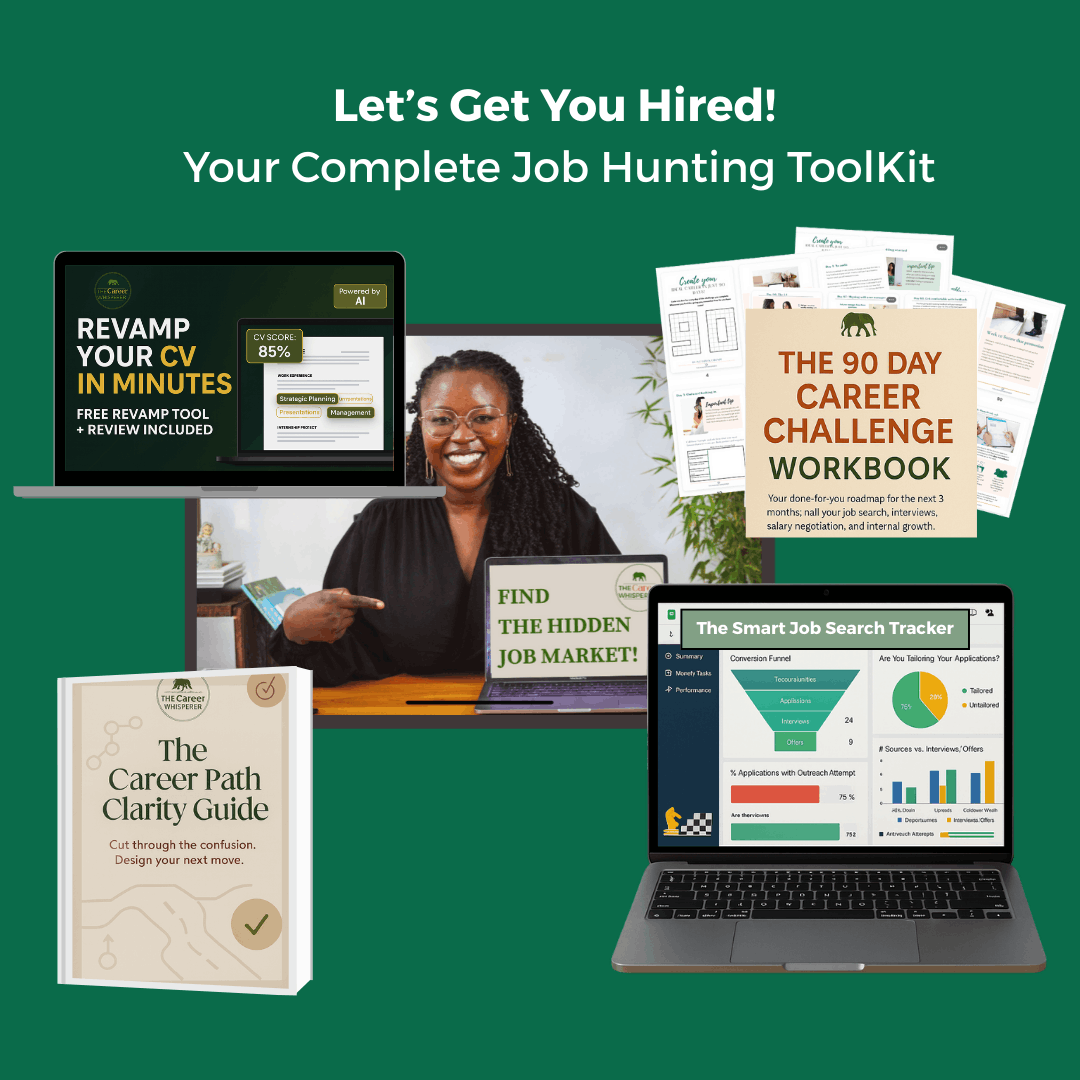
If you want a structured system for building that preparation into your job search week by week, not just the night before, the 90-Day Career Challenge inside the Let's Get You Hired Toolkit walks you through exactly how.
Want to know exactly where your job search is breaking down?
Take the free Career Audit Quiz. It takes 4 minutes and tells you precisely what to fix first. thecareerwhisperer.net